
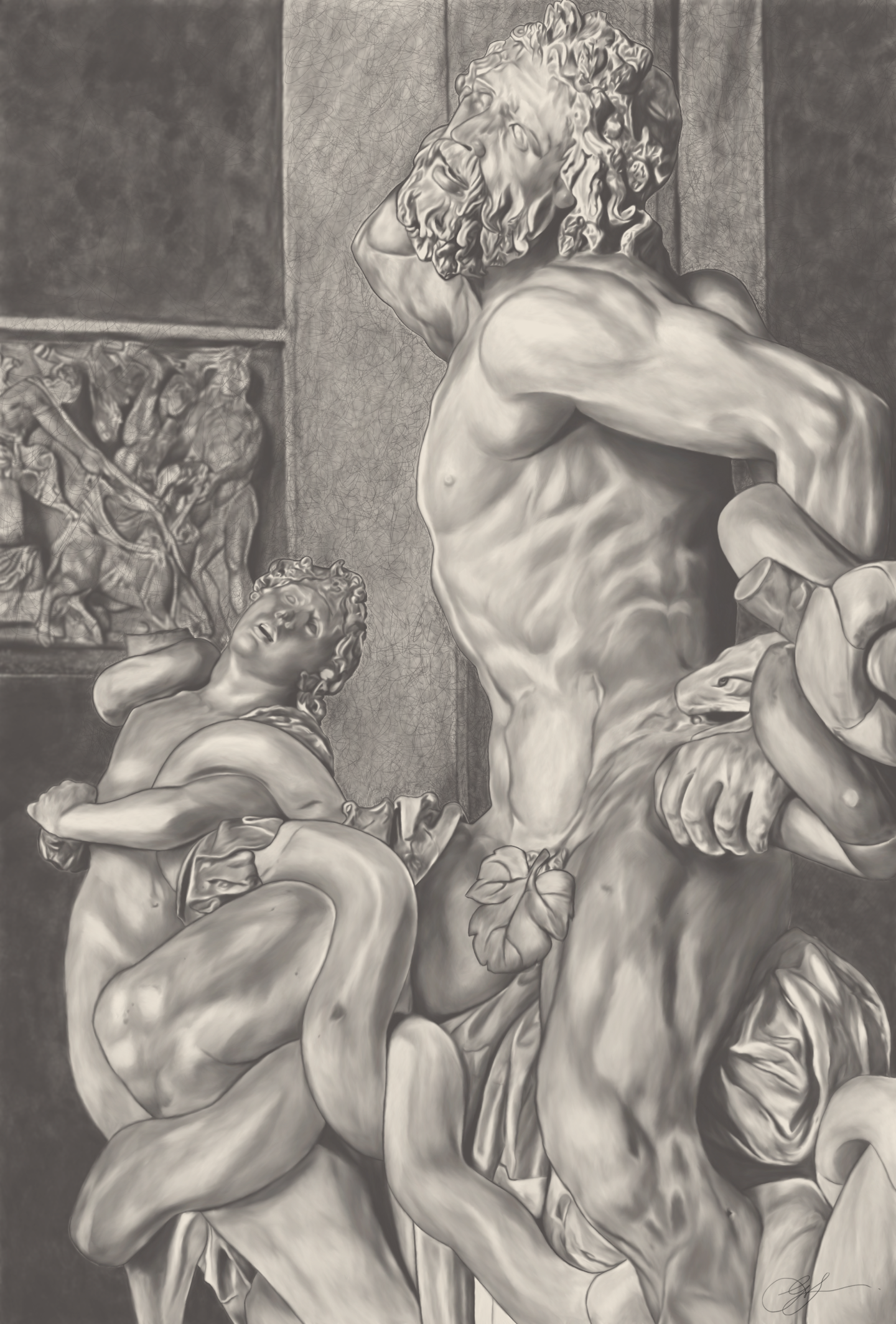
This drawing is based on Laocoön and His Sons, a sculpture that occupies a markedly different emotional register to the stillness of my last post drawing Pietà. Where the Pietà is about containment after devastation, Laocoön is about the body in the midst of it.
It does not settle.
It resists.
And that resistance is what makes it difficult to look away from.
Studying Laocoön and His Sons
The sculpture, attributed to Agesander of Rhodes and his collaborators, depicts the Trojan priest Laocoön and his two sons as they are attacked by sea serpents. It is widely understood as a Hellenistic work, designed not for calm reflection but for impact.
Unlike the composed balance of Renaissance sculpture, this piece is structurally unstable. The composition spirals. Limbs extend outward. Tension is carried through every part of the body.
There is no still centre.
What struck me most when studying it was the continuous movement across the figures. The eye does not rest. It travels—from Laocoön’s contorted torso, through the serpents coiling around him, to the smaller, more vulnerable bodies of his sons.
This is not symbolic distortion. It is anatomical exaggeration in service of expression.
The body is not idealised. It is pushed.
The Body During Violence
While some sculptures capture aftermath, Laocoön captures the moment itself. The violence is not implied. It is active.
Drawing Laocoön’s torso was central to understanding the piece. The musculature is hyper-defined, but not in a decorative way. Every contraction feels necessary. The abdomen twists unnaturally. The ribcage lifts as if struggling for breath.
The strain is visible.
His face is open in pain, but it is not theatrical in the way later Baroque works might be. It sits somewhere between endurance and collapse. There is no release.
The sons introduce a different emotional layer. Their bodies are smaller, less capable of resistance. One appears to be succumbing, the other still fighting. That contrast creates a progression within the composition.
It is not one moment. It is several, happening at once.
When drawing this sculpture, I focused on tension. On allowing lines to carry strain rather than smoothing them out. The power of Laocoön lies in what it refuses to resolve.
Close-Up Details
Laocoön’s expression was one of the most difficult elements to capture. It is not simply pain. It is effort. The mouth opens, but the body is still engaged in resistance. The face does not collapse into grief. It holds.
The serpents themselves are not passive elements. They direct the composition. Their movement creates the rhythm of the piece, pulling the figures into a continuous spiral.
The anatomy is exaggerated, but controlled. Every muscle serves the composition. Nothing feels accidental.
Drawing Classical Sculpture Without Softening It
Laocoön and His Sons is often discussed in terms of drama, but what makes it enduring is its physicality. This is not an abstract representation of suffering. It is embodied.
There is a discipline to the construction of the sculpture that becomes clearer through drawing. Despite the apparent chaos, the composition is tightly organised. The tension is deliberate.
Drawing from it requires a different kind of restraint. Not the restraint of holding back emotion, but the restraint of not simplifying it. The instinct to correct, to neaten, to make the body more comfortable—those impulses have to be resisted.
The sculpture does not need to be softened. It is already precise.
In this study, I was not interested in reducing the intensity. I was interested in observing how the body carries it.
The Classical Statue Drawing Collection
This piece sits within my ongoing series of classical sculpture drawings. Each work in the collection explores a figure whose body carries emotional weight rather than idealised stillness.
If the Pietà reflects endurance through stillness, Laocoön reflects endurance through resistance. Both are bodies under pressure. Both exist within moments that cannot be resolved.
The full collection will be available soon as high-quality prints, with additional works shared as the series develops.
Some sculptures command attention through silence.
Others through struggle.
Laocoön and His Sons belongs to the latter.
