
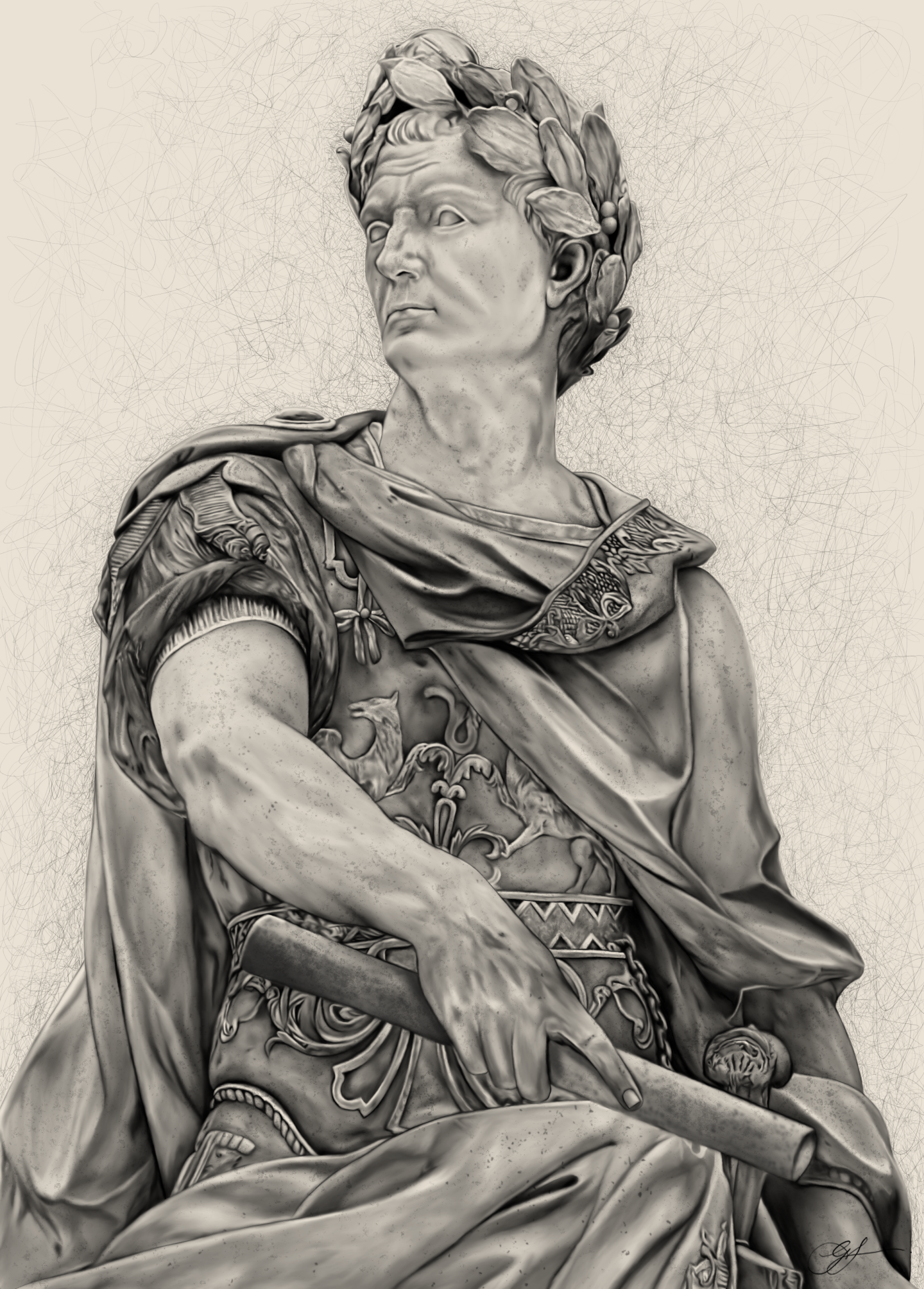
This drawing is based on the statue of Julius Caesar, commissioned in 1696 for the Gardens of Versailles to accompany Annibal by Sébastien Slodtz. The sculpture itself is attributed to Nicolas Coustou, and it occupies a different kind of presence to more overtly expressive works. There is no visible struggle, no dramatic gesture forcing itself outward.
It does not resist.
It asserts.
And that control is what makes it difficult to fully read.
Studying the Statue
Created within the context of Palace of Versailles, the sculpture reflects a specific intention. It is not simply a portrait of Caesar as a historical figure, but a constructed image of authority.
The stance is composed. The weight is balanced. There is no instability in the form. Unlike sculptures that rely on movement to carry emotion, this piece relies on stillness as a form of dominance.
What becomes apparent when studying it closely is how little is exaggerated. The body is idealised, but not to excess. The drapery is controlled. The gesture is minimal.
The power is not in what the figure does. It is in what it does not need to do.
This is not a man in action. It is a man already established.
The Body as Authority
There is no visible violence here, but there is an awareness of it. Caesar’s identity is inseparable from conquest, yet the sculpture does not depict him in battle. Instead, it presents the aftermath of power consolidated.
Drawing the posture was central to understanding the piece. The torso is upright without strain. The limbs are positioned with intention but without tension. Nothing appears accidental.
The face carries the same restraint. It does not reveal. It withholds.
There is no need for expression to communicate authority. It is embedded in the structure of the figure itself.
The drapery contributes to this. It is not decorative. It frames the body, reinforcing the verticality of the stance. It creates weight without disrupting balance.
When drawing this sculpture, I focused on control. On maintaining clean, deliberate lines rather than allowing them to loosen. The power of the statue lies in its precision.
Close-Up Details
The expression was one of the most difficult elements to capture. It is not emotive in a conventional sense. There is no visible anger, no pride pushed to the surface.
It is contained.
The gaze does not engage directly. It feels directed beyond the immediate, as if the figure exists within a larger context of power rather than within the moment itself.
The anatomy is idealised but not exaggerated. The proportions are measured. The stillness of the body reinforces the psychological distance of the figure.
Drawing Classical Sculpture Without Projection
Statues of figures like Caesar are often approached through narrative, but what makes this piece effective is its refusal to rely on it. The sculpture does not tell the story. It assumes it.
There is a discipline in that choice. Nothing is over explained. Nothing reaches outward for interpretation.
Drawing from it requires resisting the urge to add character where it has been intentionally withheld. The instinct to humanise, to soften, to introduce visible emotion – those impulses have to be controlled.
The figure does not ask to be understood. It asks to be observed.
In this study, I was not interested in uncovering personality. I was interested in how authority can be constructed through form alone.
The Classical Statue Drawing Collection
This piece sits within my ongoing series of classical sculpture drawings. Each work in the collection explores a figure whose body carries a distinct kind of presence rather than overt expression.
Alongside this study, the series includes drawings based on Moses by Michelangelo, The Ecstasy of Saint Teresa by Gian Lorenzo Bernini, and The Rape of Proserpina, also by Bernini. Each of these works explores a different relationship between the body and emotion—whether through restraint, transcendence, or physical intensity.
If some sculptures communicate through movement or emotion, this one communicates through restraint. It exists in a space where power is already secured, not contested.
The full collection will be available soon as high quality prints, with more works shared as the series develops.
Some figures demand attention through action.
Others through intensity.
This one holds it through control.
